Driven by Curiosity: Weston Tayebati ‘28 Finds His Path in Engineering
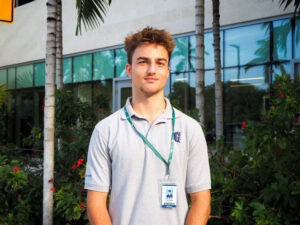
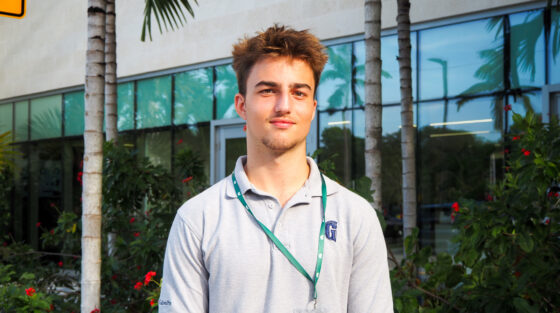
For Weston, engineering is not simply about solving a difficult problem. It is about loving the process enough to stay with it when the answer does not come easily, then using what you learn to create something that can make a difference.
That passion has already taken him from Gulliver classrooms to the University of Cambridge and into professional engineering environments, where each experience has helped him better understand the field he hopes to pursue.
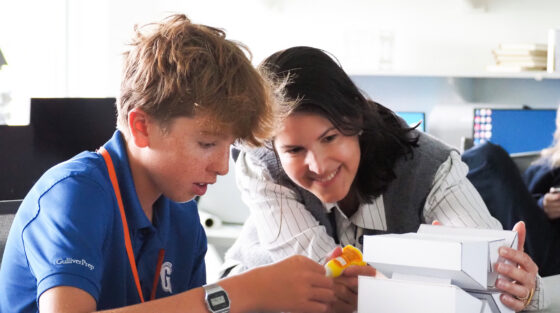
Weston first discovered his interest in engineering during his freshman year while living in Massachusetts. A physics project challenged him to build a miniature arcade game using a force sensor, LED lights, speakers, and an Arduino. The experience transformed a childhood love of building into something more.
“Since I was little, I have always liked building things, like Legos, but building a mini arcade game showed me that I was capable of making real systems,” he said.
 Last summer, Weston took that interest to Corpus Christi College at the University of Cambridge, where he studied engineering through Immerse Education. For his final project, he chose quantum teleportation, exploring how the state of a qubit can be transferred using quantum entanglement and classical communication. He then used Python and Qiskit to simulate the process.
The project required late nights, repeated problem-solving, and plenty of moments when Weston was unsure whether he would reach the result he envisioned. He kept going. After his tutor encouraged him to submit the work to the program’s competition, Weston earned first place.
That willingness to lean into difficulty rather than away from it continues to shape how Weston approaches STEM.
“When you are extremely driven and passionate about achieving something or solving a problem, it’s almost like tunnel vision,” he said. “You see hardship as just another brick in the wall, a speedbump in the road.”
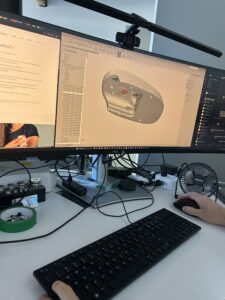 This summer brought a new opportunity to put that mindset into practice. After completing an advanced pre-calculus course at Gulliver, Weston traveled to San Diego for an externship with Neoenta, a design and engineering firm working on medical technology. He learned to use specialized equipment and observed engineers developing devices designed to make healthcare diagnostics more accessible.
The experience shifted his thinking about what engineering could mean for his own future.
“I watched some of the nation’s finest engineers work diligently every day, pouring in their knowledge for a purpose larger than them,” Weston said. “My goal in general is to develop something that saves someone time, costs them less money, less stress, and less thought.”
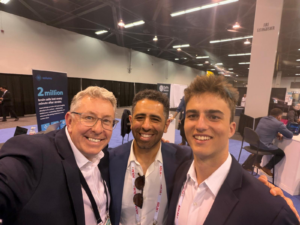
Weston also attended the Association for Diagnostics & Laboratory Medicine conference with Neoenta, where he saw firsthand how engineers present their work and communicate complex ideas. When he found himself answering questions from industry representatives at the company’s booth, he drew on an experience that began in Mr. Rossi’s chemistry class at Gulliver.
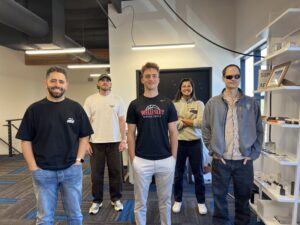 In class, students presented laboratory results through simulated business scenarios and fielded unscripted questions from teachers. The exercise taught Weston that truly understanding your work matters more than memorizing what you plan to say.
“You can’t just know your scripted spiel,” he said. “You have to know it top-down.”
It was a classroom lesson that suddenly had a purpose far beyond the classroom, and one of many experiences helping Weston connect what he is learning today with the problems he hopes to solve tomorrow. Gulliver’s approach gives students opportunities to follow genuine interests, take on increasingly difficult work, and apply their learning in meaningful contexts. Weston’s path reflects that progression from curiosity to capability, and ultimately, purpose.
For Weston, success is taking shape through both what he has accomplished and the person those experiences are challenging him to become. A first-place engineering project matters, but so does the persistence behind it. Technical knowledge matters, but so does discovering how that knowledge might serve others. That balance is helping Weston shape a future that feels distinctly his own.
And his advice to students hoping to find their own path in STEM is simple: find the part that genuinely excites you and pursue it.
“That passion is what keeps you in the game and it allows you to become the best you can possibly be at it,” Weston said. “Without passion, you aren’t maximizing your potential.”