Growing a Love of Reading and Writing in Fourth Grade
“Mrs. Greenberg, could I read Lifeboat 12? I was talking to someone in the other book club, and he said it was great!”
For Cindy Greenberg, a fourth-grade teacher at Gulliver Prep, what stayed with her about that request was the conversation she hadn’t heard. Two students reading different books had talked on their own, and one had come away wanting to read the other’s recommendation.
“The fact that my students were talking to one another about literature, completely unprompted by a teacher, spoke volumes to me,” Greenberg said. “I knew I was on to something.”

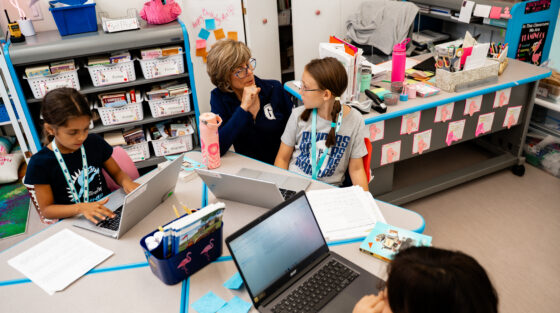
In Ms. Greenberg’s classroom, several book clubs run at once, each small group reading a different title. There’s no test at the end of a book. Students get to talk about what caught their attention, and Greenberg gives them reasons to go back to the page. One book club activity asked students to imagine what a character would choose for Halloween. They could dream up any costume, but they had to explain why their character would pick it and find details in the story to support their thinking.
Sometimes, those conversations lead students to a book they might have passed over. Greenberg makes room for that kind of discovery at the end of each day, too, when she reads aloud to the class. It’s a chance for students to meet an unfamiliar author or try a genre they might never pull off the shelf themselves.
“Students shared recommendations, influenced one another, and came to me for their next book because they genuinely wanted to read more,” she said.
Writing a Story Someone Else Can Feel
During the unit Medieval Knights and Castle Life: Europe’s Middle Ages, students read informational texts about how people lived and learned to support their answers with evidence. Then they chose someone from the period whose day they wanted to imagine in writing. Greenberg was struck by how many chose to write about people with the least power. She saw empathy in their curiosity about what an ordinary day might have felt like for someone whose life was especially hard.
A historical fiction read-aloud gave the class something to draw on. Students remembered how vividly they could imagine a character’s fever and her worry about the sheriff. As they returned to their own drafts, Greenberg asked them to think about the person on the other side of the page. “Can they see? Can they really see? Can they feel it?”
For one young writer, the question came down to the sound of a bell waking her character. In her draft, the clang whistled past the character’s ear. As she and Greenberg talked it through, they wondered whether a whistle sounded too gentle. What if the bell rang so loudly that her character could feel her ears vibrate?
The student knew what she wanted her reader to hear. Now she had a reason to go back into her sentence and find the words for it. It’s a connection Greenberg sees every day. As she put it, “that love of reading helps them become better writers!”
At Gulliver, curiosity is a core value, and Mrs. Greenberg gives her fourth graders time to practice it every day as they ask questions, share discoveries, and explore their own ideas in writing.